
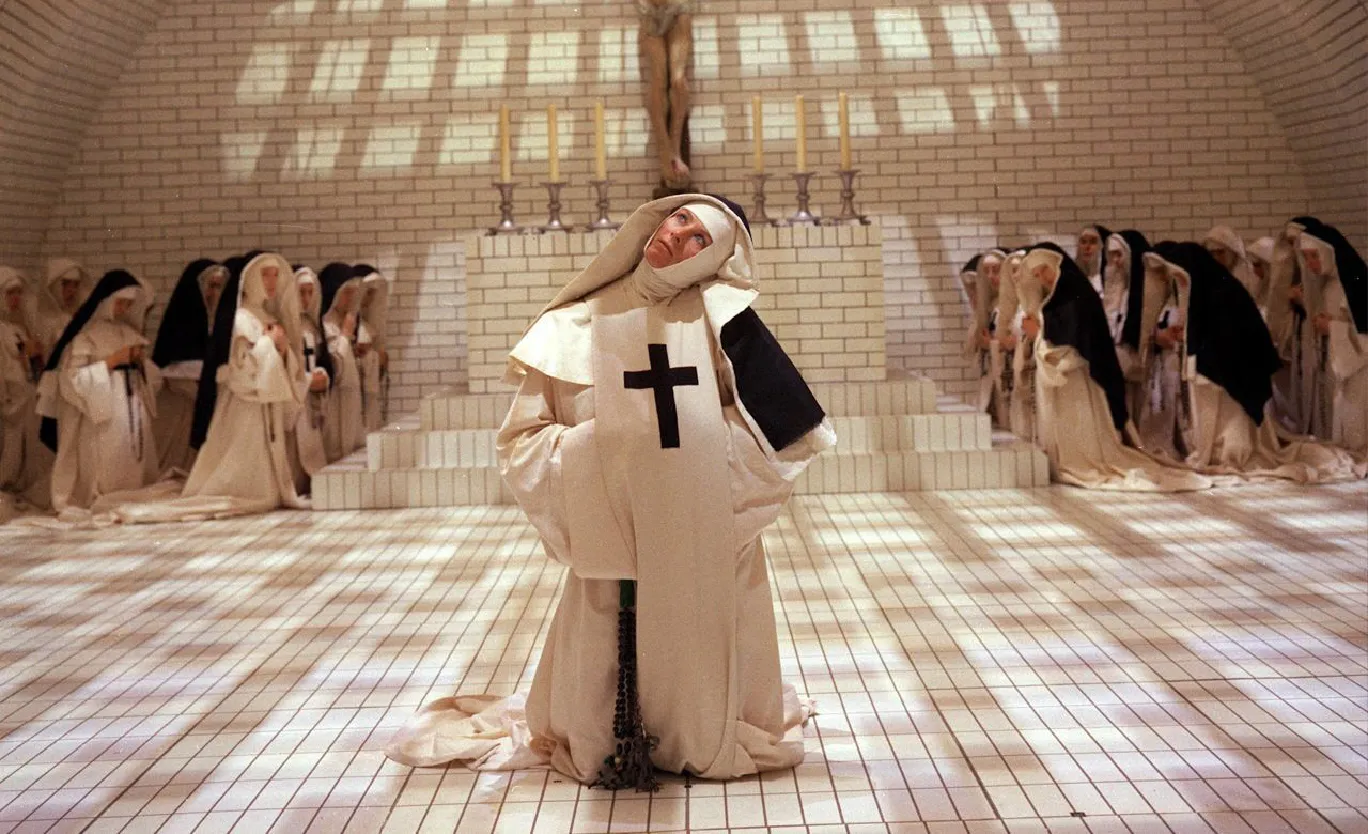
When provocative British director Ken Russell, known for pushing every cinematic boundary in every genre in his 40+ year career, released The Devils in 1971, he faced opposition and derision on all fronts. Countries either censored or outright banned it over its blasphemous scenes of nuns desecrating a church and a multitude of other perversions. Audiences and critics didn’t seem to know what to make of its garish, experimental production design and a tone that could veer from outrageous camp to outright horror.
Newly restored as Russell originally intended, The Devils is based, more closely than you’d think, on true events in 1630s France where, in order to consolidate a France consisting of loosely connected city-states into an iron-fisted monarchy, the Catholic Church, in conjunction with the throne, instigated accusations of witchcraft and mass hysteria to bring down the fortified walls of Loudun and its imperfect protector, Father Grandier (Oliver Reed). This was my third or fourth time seeing The Devils, and finally seeing it as intended let me truly understand its absurd glory. And, more surprisingly, how relevant it felt to a world more than half a century later.
Making art for a bleak, absurd world
The Devils opens with King Louis XIII in drag, wearing a clamshell bikini as he reenacts “The Birth of Venus” for Cardinal Richelieu, the kingdom’s true ruler. It starts ridiculous and never stops building in grotesquerie, featuring nuns masturbating with charred bones, sexual fantasies of Jesus Christ, and graphic torture that wouldn’t be out of place in a Saw film.
The tone shifts from laughter to abject horror as needed, in a way that feels similar to Zach Cregger films, though pushed to a more surreal level. It’s also similar to what Digger tried to do most recently: break cinematic rules with a meta piece of art that dared to tackle the world’s current apocalyptic state. The Devils feels just as extreme and boundary-pushing, if not more so.
How the powerful weaponize religion against us
Despite the sinful hedonism of France’s elites, they’re able to easily manipulate people against their best interests through the Church. Far from a heretical work, Russell pits faith and personal morality against religious corruption, shown in one scene where Cardinal Richelieu walks through a part of the church that looks like a cross between Fort Knox and a prison, with each cell packed with money.
When a cloistered mother superior (Vanessa Redgrave) starts to lose it over her lust for Father Grandier, it’s an all-too-convenient culture war issue for the Crown and Church to unite behind. They can discredit Grandier, who inspires the men of Loudon to stand up for their city, by creating hysteria that he’s infected a group of nuns with literal devils. And of course, the townspeople fall for it, even as the nobles laugh in their faces and nakedly expose their hypocrisy.
Beyond the Trump era, society as a whole keeps falling for culture war issues. Look at the comment section of any benign social media post and you’ll see people (or bots) tear each other apart. Meanwhile, the planet’s failing, the rich get richer, and, if you can ever afford a house, you’ll end up in an HOA behind a data center.
Just as I went through my final edit of this piece, there was an expose on Senate candidate and Texas attorney general, Ken Paxton, partying with his mistress in Dubai with two fugitives who stole money from hospitals. This is, of course, the same man whose aggressive abortion prosecutions have prevented women from receiving life-saving medical care. Even Ken Russell might be shocked by how ridiculous the people who lord over us are.
Perfection doesn’t have to stand in the way of goodness
When we meet Father Grandier, he’s a big piece of shit. He uses his position and roguish mustache to break his vows by sleeping with every woman possible before finding a path to love and back to God. Though his indiscretions and failure to atone for them do contribute to his downfall, he doesn’t let that stop him from standing up for his town and refusing to back down from his convictions, even as the town falls to mob rule and he’s brutally tortured.
In today’s hyperonline culture, whatever your political affiliation, conforming to some idea of perfection or ideology can feel unachievable and disheartening, to the point that you waste your time virtue-signaling or cowering instead of doing right by your community. Whether you’ve done bad things or, like all of us, are imperfect, it’s never too late to do right and stand by your convictions (unless those convictions are to exploit others for your own limitless power, of course).
Even Ken Russell might be shocked by how ridiculous the people who lord over us are.
We see a two-tiered system in The Devils, where the men in power, including Father Grandier, can do whatever they want to sate their desires without consequence. Outside of that tier, people die of plague and Protestants oppressed by the state are murdered for sport. Women have no agency over their bodies, existing to be taken by awful men, and their only recourse is inflicting pain and misery, even in the case of Vanessa Redgrave’s incredible performance as Sister Jeanne, at the cost of their own sanity.
The cloistered convent, just one of the many incredible sets created by the future experimental filmmaker Derek Jarman, is another type of prison with literal bars at the windows; to get a look at the object of her obsession, Sister Jean has to unlock a door and crawl on her stomach to look at him from a barred window just above the surface of the street. Her and the other nuns’ inability to control their own bodies and pleasure is a cause of their madness, which they’re only allowed to access at the coercion of a Church that only sees them as disposable.
Ten years on from the “Me Too” era, amidst the justified fury about the “Cornell 7,” no justice for the victims of Jeffrey Epstein and his many “disciples,” and a litany of other horrid examples, we haven’t seemed to move far beyond a movie made 55 years ago about a story set in 1634.

Leave a Reply