
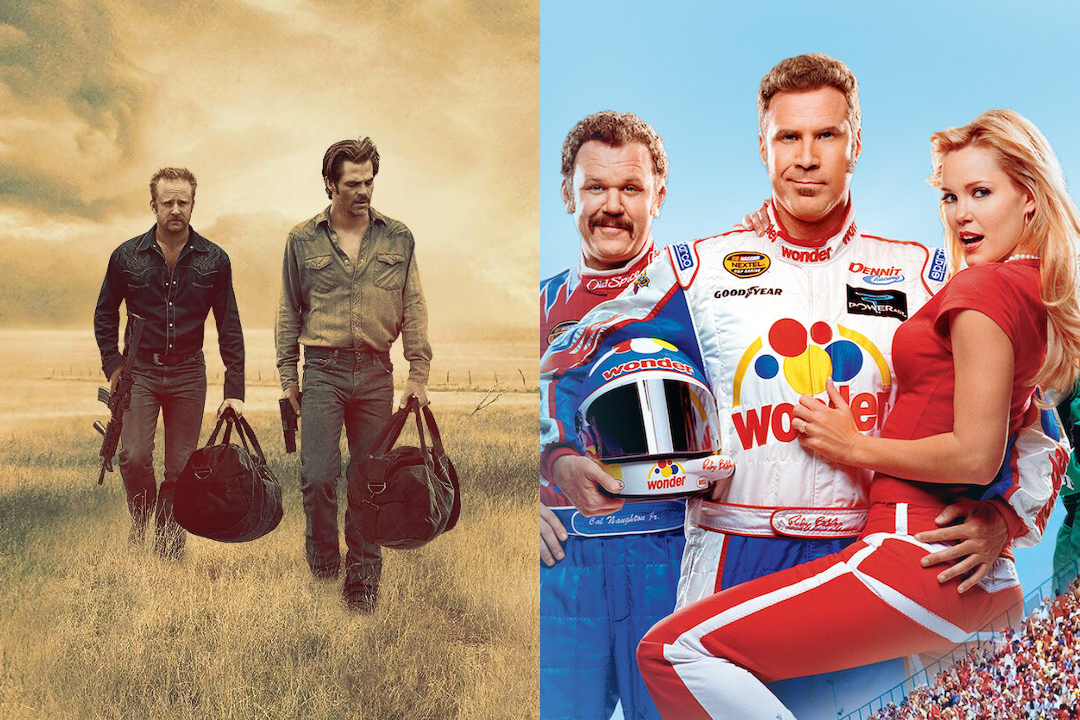
If you want to understand the United States before and after the Great Recession, you could do a lot worse than putting Talladega Nights: The Ballad of Ricky Bobby and Hell or High Water on opposite ends of the same timeline.
As a native Texan who graduated college in 2008, right as the U.S. financial system decided to eat shit and die in a fire, I realized these two movies—celebrating their 20th and 10th anniversaries respectively—are accidental bookends to the country I grew up believing in versus the one I actually inherited.
Get Rich and Don’t Ask Questions
Written and directed by Adam McKay, Talladega Nights is both Will Ferrell and 2006 America at their most full throttle. It’s loud and kinda stupid in a way you look back on with fondness, absolutely convinced the good times will last forever. Ricky Bobby is more than just an avatar for pre-crash American optimism. He embodies the philosophy that if you work hard, you’re gonna win and, conversely, if you ain’t first, you’re last.
If you’ve got the money to turn your living room into a fucking NASCAR-themed Applebee’s, congrats! You’ve cracked the code to the American Dream and Baby Jesus in the manger salutes your bravery!
The movie is ridiculous (and ridiculously funny) because the country it parodied displayed this very real cultural faith: work hard, get rich, buy shit, go fast, and don’t ask too many questions when the bill comes due.
And then, 2008 happened.
Graduating college that year felt like being handed a diploma while the entire economy drove into a concrete highway barrier. Oh and by the way, there aren’t any jobs available and everyone’s poor now. Cool. Very cool. Very good. The assumptions I’d grown up with as a working-class gal from rural Texas started looking less like guarantees and more like bullshit marketing copy.
That’s where Hell or High Water comes in.
A Homeless Hangover
Written by Taylor Sheridan and released ten years after Talladega Nights, David Mackenzie’s Hell or High Water feels like a hangover, and not a classy dry-red hangover either. This one bites, like one too many vodka Red Bulls after a night of dancing with your friends in 2007, which is a too-apt comparison for this particular topic. Instead of the loud, confident setting of Talladega Nights, we see foreclosure signs, dying towns, predatory banks, empty Main Streets, and people scraping to get by and hopefully not lose their homes.
Toby and Tanner Howard (Chris Pine and Ben Foster shining like the stars they are) aren’t chasing some inflated American Dream. They’re really just trying to rob its corpse because that rotten corpse wronged the entire family line. Banks already took the land, and the previously solid oil economy isn’t gonna save your sorry ass.
Unlike many other films that take place in my home state, Hell or High Water captures the rural desperation of dying Texas towns during this time. The boredom and uncertainty are all there in a way that feels almost uncomfortable. Characters in this world weren’t asking how to get rich, but how to prevent their families from becoming homeless. It feels less like a crime movie and more like a goddamn obituary.
That distinction? Well, brother, that’s the entire damn story.
The assumptions I’d grown up with as a working-class gal from rural Texas started looking less like guarantees and more like bullshit marketing copy.
Talladega Nights is a funny fantasy about a country where excess is your reward. Hell or High Water is a sometimes funny tragedy about a country where survival itself became the reward.
When viewed from the perspective of a Texan who graduated straight into the Great Recession, they feel like snapshots taken from both sides of a continental divide. We speed-ran from “If you work hard, you’ll win!” to “holy shit, nobody can find a job!” One drove 200 miles per hour with a damn cougar in the passenger seat while the other sat in a bank parking lot wondering how many more people they needed to rob.
Somewhere between Ricky Bobby’s children Walker and Texas Ranger becoming well-mannered and Toby Howard riding off into the West Texas sunset, the script changed completely.
