
2026 / Dir. David Fincher
Watch if you like: Once Upon a Time in Hollywood; the small subset of films written but not directed by Quentin Tarantino; a break from playing Grand Theft Auto VI but want to scratch the same itch.
Cliff Booth (Brad Pitt) is that unemployed friend of yours who’s going skydiving before having drinks at a private club on a Tuesday while you’re stuck at the office, even though you know he doesn’t have rich parents, so maybe he’s a drug dealer, or maybe you’re just a chump? I guess he’s not exactly unemployed. Since we last saw the former stuntman fending off the Manson family in Once Upon a Time in Hollywood, Cliff spends his time managing a movie theater, working at a tiki bar, upselling drunk tourists on banana margaritas, and occasionally working as a Hollywood fixer for celebrities who get into deep shit.
Like Charlie Peters (Scott Caan, Hawaii Five-0, Entourage), a TV action star with a Napoleon complex who got a little too comfy with a pair of Filipino gangster brothers that now want to kill his wife (Carla Gugino, Watchmen, Lisa Frankenstein) if Peters doesn’t cough up 200,000. But like the previous film, it’s more about the frequently hilarious encounters Cliff has and the hangouts along the way than driving straight to the inevitable violent confrontation between Cliff and the gangsters.
Scripted by Quentin Tarantino but directed by David Fincher, The Further Mis-Adventures of Cliff Booth still feels very much like a Tarantino film. After all, it opens with a faithfully ridiculous faux-blaxploitation movie called Soul Brothers Die Hard! Even the little details that populate the “Tarantinoverse,” like Red Apple Cigarettes and Big Kahuna Burger, all make an appearance. Fincher, known for his meticulous shoots where a single scene can require a hundred takes or more, does feel like he’s crafted in some of Tarantino’s excesses, like the lengthy asides about TV westerns that could dampen the momentum in the first movie.
The few spurts of violence in the film feel colder and more sinister than Tarantino’s usual cathartic orgies of blood that punctuate his films. That’s perhaps because there’s more heart to Cliff Booth and, thus, a greater emotional stake. Besides being this mythical badass, Booth is also a guy with no real direction in his life, living in his dad’s (a curmudgeonly Peter Weller who doesn’t like it when you talk during his shows) spare room. There’s a sweetness to the interactions between father and son, who spend time making World War II models together, not usually found in Tarantino pictures.
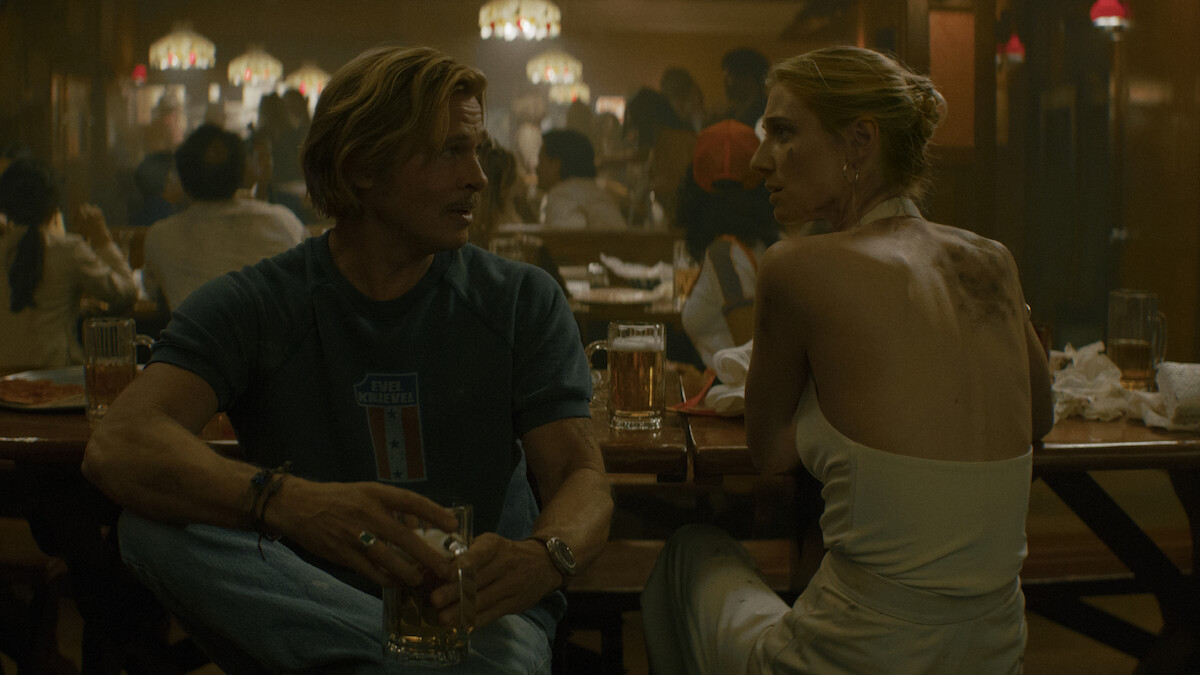
Even more tender is the budding romance between Cliff and Karen Crosby (Elizabeth Debicki, The Crown), Scott Peters’s agent, that replaces the buddy comedy of the first movie. Crosby is initially tasked with tracking down Cliff, unaware of Peters’s gangster issue and thinking it’s for a new TV project. While the prim and proper Crosby and the uncouth Booth seem like they’d get along like oil and water, soon the two are circling each other into each other’s worlds, culminating in a wild demolition derby where the other half of the reported $200 million that didn’t go into Pitt, Fincher, and Tarantino’s pockets likely went. In a cast without as many big names as the first movie, other than Pitt, Debicki is a highlight, going toe to toe, even literally beating him down to size, like she was as big of a movie star as Margot Robbie.
Though Fincher and team dutifully recreate 1970s Los Angeles with that same huge budget, Cliff Booth doesn’t feel as much like an attempt to encapsulate that time period as Once Upon a Time in Hollywood did in memorializing and resurrecting 1960s LA. If anything, this feels like more of the same, the next episode of the Cliff Booth series rather than any sort of grand statement, which is perfectly fine with me. If you haven’t been on the Tarantino bandwagon before, there may be enough rough edges sanded down by Fincher to make this an appealing entry point, but, for the most part, this one is for the already converted.
Side Note: As reported, David Fincher used apparently quite a bit of AI in the making of the film, which may change your opinion depending on your stance on generative AI. While I did notice Brad Pitt’s face looking unusually “soft” at times, I wasn’t looking for AI oddities, and nothing took me out of the experience. I do find it strange that this movie cost twice as much as Once Upon a Time in Hollywood and needed so much AI effects work, yet didn’t deliver a bigger experience than the first film, either.

Leave a Reply