
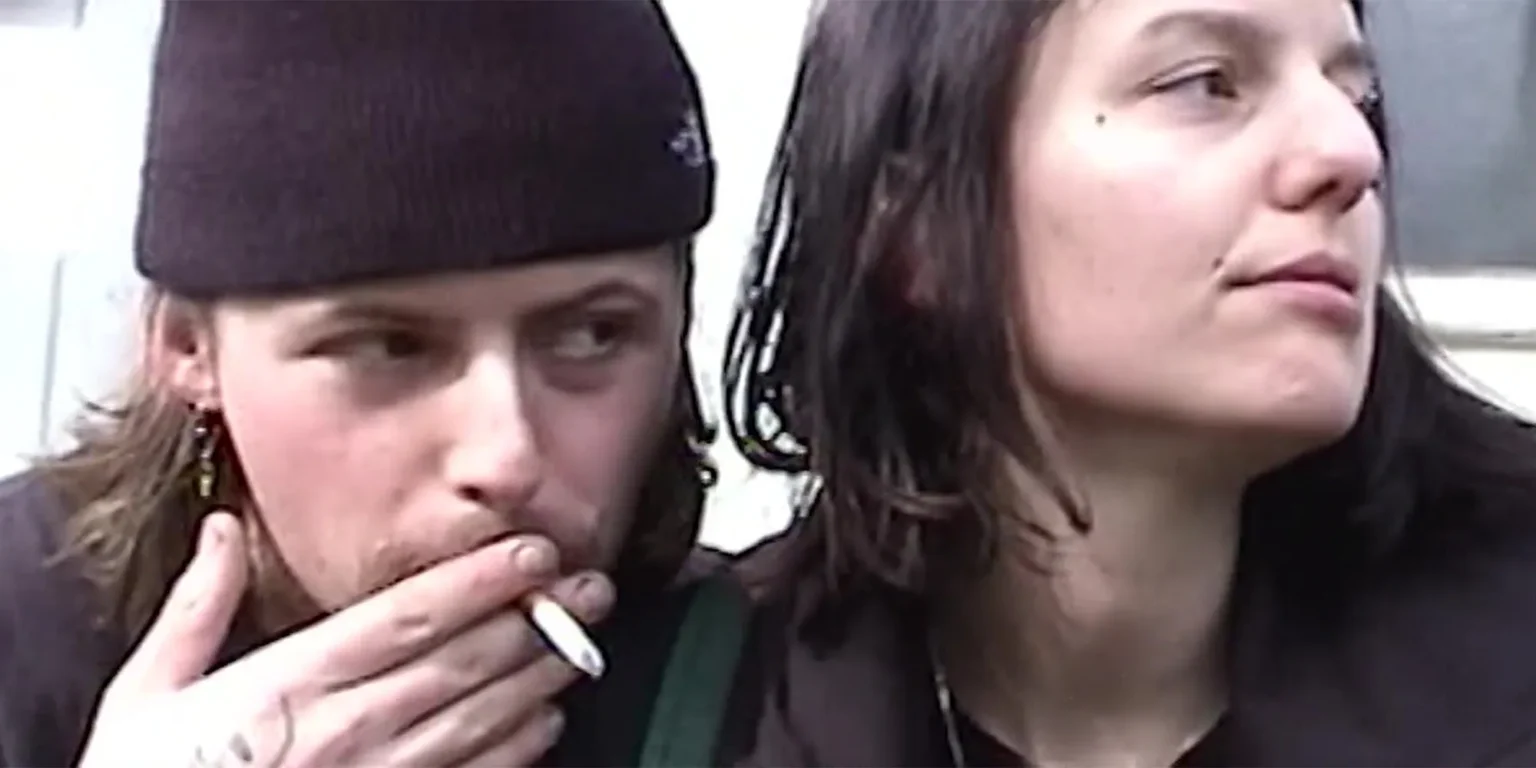
2026 / Dir. Louise Weard / 2026 Chicago International Film Festival
Watch if you like: a nightmarish yet hopeful version of 2000s mumblecore filtered through an internet hellhole of incels and TERFs.
If you’re new to independent filmmaker Louise Weard’s Castration Movie Anthology, Chapter iii.ii Junior Ghosts—Premorphic Drift, despite its title, is actually a great place to start. An ongoing, low-budget series shot on an early digital home video camera, Castration Movie Anthology features an expanding universe of flawed, deeply human people navigating a world polluted with the worst of terminally online culture. Often featuring long, unbroken takes of conversations between its characters, Castration Movie actively violates many core expectations of film, including runtimes that have reached five hours, creating its own cinematic language and teaching audiences how to view and understand it.
That makes them hard to review because you can only compare them to other parts of the series. Premorphic Ghosts, though, is, in some ways, a more conventional chamber drama focused on only a couple of characters, with a standard two-hour runtime. It’s a self-contained excerpt of Weard’s Chapter iii, with the other part set to be released by the end of 2026. And though its central characters appear in Castration Movie Anthology i., you don’t need to have seen any other parts to understand what’s happening.
To get all that out of the way, Premorphic Drift starts in the aftermath of an incel attack on a support group for grieving mothers who have lost children. Sometime later, Izzy (independent director Avalon Fast), a suicide hotline operator, answers a call from one of the women in the attack. Shot handheld in largely unbroken close-ups, we never see the other woman, and clearly feel the growing discomfort as we start to understand that Izzy knew the perpetrator of the attack. Izzy’s feelings about the attack or attempts to deal with it are never fully dealt with, but shade everything that’s to come and is paralleled later.
Izzy lives with her very friendly yet directionless boyfriend, Trent (Henri Gillespie), of nine years, whom she complains about to her friends and makes fun of to his face for his “feminine” mannerisms, but enjoys being in control. That all changes when Trent comes out as trans and starts living as Tiffany, modeling herself after Izzy in many ways, including taking the spotlight in the relationship. Izzy reacts very badly, going down transphobic internet rabbit holes to become a TERF, while Tiffany begins moving forward earnestly, simultaneously starting to question their relationship.
Part of the twisted beauty of Louise Weard’s films is saddling these characters with the baggage of internet forum culture while still letting us see them as human and not grotesque caricatures. With the Izzy character, you jostle from understanding her uncertainty around her partner’s transition to seeing a deeply wounded person, or maybe just a narcissist. The extended conversations and camcorder aesthetic make it feel like we’ve been dropped into two people’s living room, privy to their darkest thoughts and most intimate moments.
It’s not all doom and gloom, though, as these movies are also really, really funny. Midway through, Izzy and Tiffany go to a support group for trans women and their partners that’s led by Weard’s recurring character, Michaela. Right before that, we see Michaela get constructive criticism from her bosses—including Jane Schoenbrun, director of Teenage Sex and Death at Camp Miasma—about her aggressive approach to criticizing group members for how they act and dress, and then, like a trans-version of Larry David, completely going against all their feedback in the group meeting.
These movies aren’t for everyone, and even in a shorter entry like this, there is a learning curve. You have to pay close attention, and at the same time you’ll wonder, why do I need to watch Tiffany skateboard for so long? But if you do get it and tune into Weard’s unique frequencies, you’ll quickly become obsessed. If you love strange, unique independent cinema that wrestles with the complex issues our world faces as more and more people turn to dark corners of the internet and drag all of it to the surface, this will be for you.

Leave a Reply