
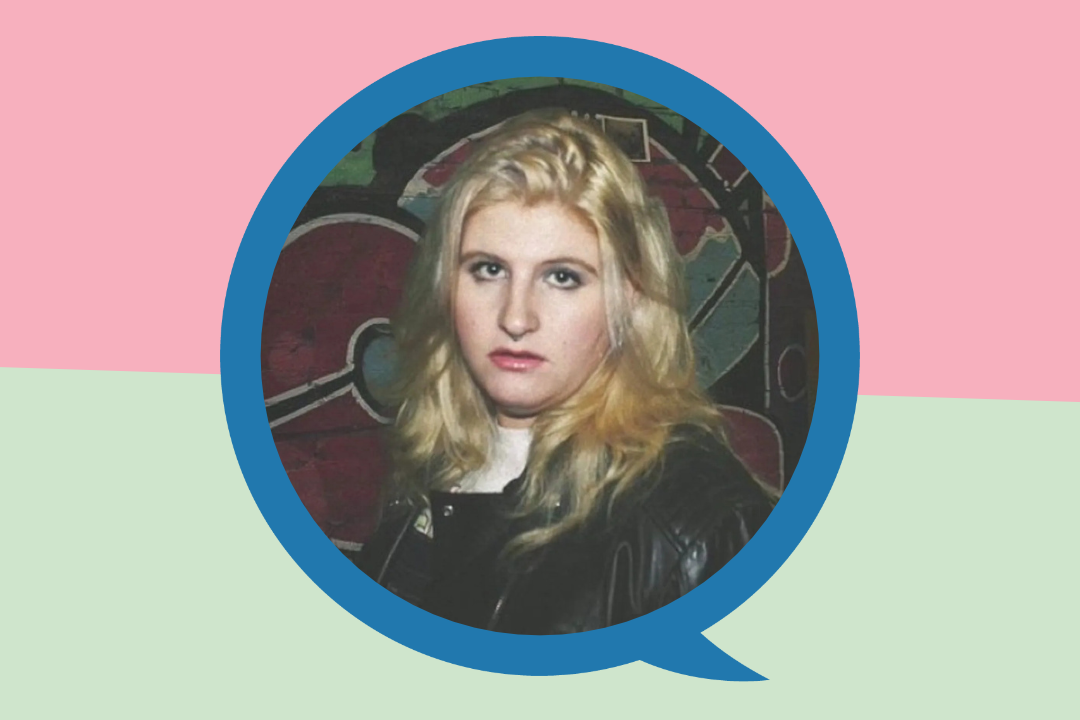
In Maker’s Dozen, we ask folks in and around the film industry 12 questions and have them ask one of us.
Louise Weard is a filmmaker best known for the Castration Movie Anthology series. The latest entry in the series, Castration Movie Anthology iii.ii Junior Ghosts—Premorphic Drift, was screened at the 2026 Chicago International Film Festival.
In this interview with our chief critic James Podrasky, Louise talks about balancing structure and spontaneity, why the anthology is an exercise in empathy, the exciting new generation of DIY filmmakers, and more!
This interview has been edited for content and clarity.
1. What’s the Louise Weard origin story?
I’m the director behind the film series known as Castration Movie, which is one very long movie that we’ve been releasing one chapter at a time over the last four years. It’s kind of a crazy mega project. It’s about everything, but takes a focus on trans characters and reckons with the trans screen image over a movie, which is dozens of hours long. I’ve been working on both my own films and other people’s films since 2013. I spent a long time producing and working as a cinematographer and production assistant on many big Hollywood sets, and then finally decided to make this movie. Now I’m four years into this process, so it just keeps going.
2. Your two leads in your latest, Junior Ghosts, first appeared in smaller roles in Castration Movie Anthology i. Was it always the plan to bring them back? And how did Henri Gillespie and Avalon Fast react to the idea?
Yes, 100%. There was other stuff we were gonna do with those characters in the first movie, and then it all kind of got coalesced into what we have released as this chapter now. We always knew where those characters were going to end up and how they related to the lead character of the first chapter. It was all mapped out pretty cleanly. There’s some things we changed just because of the passage of time. It was really fun to get this one released because we actually shot it much closer to the production of that first chapter. For that first scene, when I was directing them I didn’t need to tell them, “Here’s the whole arc of the characters.” I just asked them, “Are you down to be in this movie?” And then they just needed to know what they needed to do for that scene. At this point, they have a good idea of where these characters are ending up in a greater story.
3. Castration Movie features many long, uninterrupted conversations. How many times do you have to film some of these scenes? Are they rehearsed beforehand or improvised?
I’m very specific in what a scene needs to do. Everything has a functional purpose. Even though I’m not there with a stopwatch, I’m feeling the pacing out as the director in the scene and knowing that we have to guide from point A to point B to point C. So all the dialogue is really put together where I’m giving all the key lines, the key beats. We block everything that happens in the scene so everyone knows where they have to be, where they say this, how that works. But then we leave that extra bit of room for the actors to find the timing and make sure those beats come in a natural order. And then we kind of solve problems on the day, where sometimes I can tell two actors different things and then we get to see what happens in the spontaneity of that moment.
4. You’ve been doing screenings of Chapter iii.ii Junior Ghosts—Premorphic Drift. How have audiences responded to a more digestible chunk of Castration?
I think the people who are already on board the project and invested look at this as like, “I’m left wanting more. I can’t wait for the next one. This is too short for me.” They want the next chapter right away. But it’s been really nice working with Liz and the team at Muscle Distribution, and then my team for Europe at Matchbox Cine are just fantastic at being like, “We have this more palatable running time, let’s try to get this everywhere we can.” It’s been a really cool opportunity to play this one more widely.
5. Recently everyone became obsessed with the COVID-conscious lesbian bar, in part because of this intense code of social ethics. In your movie, your characters are messy and rarely do the socially acceptable thing, like Avalon’s character Izzy whose reaction to her partner Tiffany coming out as trans is less than ideal, or your character Michaela who runs a support group and is involved in a hilarious conversation about all the things she shouldn’t say, which she promptly does again in the next group session. You also make these characters very human.
I think the whole film is an exercise in empathy. It’s me trying to look at characters who feel very different from myself and try to understand them. I don’t agree with the choices they make or their behavior by any stretch, and a lot of the audience doesn’t either. But you can at least see how someone could do that on purpose. Especially now with the internet, we’re surrounded by hateful language all the time. Like the example about the bar, people recreate these systems of power and social hierarchies that you would hope they would know better to try to not recreate. They’re trying to escape from these systems of power, but then end up recreating this microcosm of them. The second chapter is all about the way in which those cycles of recreating these systems of power play out. They should let me adapt the movie version of that article.
6. This film begins in the aftermath of an incel attack that colors the rest of the film. Internet rabbit holes that lead to radicalization, transphobia, bigotry, etc. reappear in your films. Are we doomed as a society?
What I really hope is by making people talk in a movie and say these horrible things that should stay on a computer screen will make people embarrassed enough to think, “Maybe I shouldn’t talk like this.” I do think that’s so much of what these movies are about. The way in which we’ve allowed ourselves to fall so far in terms of the ways we communicate with other people, where someone’s saying something so horrible into the computer, which is a very anonymous, faceless device—now imagine trying to say that to someone’s face. I think that’s what the power of cinema is able to do. What’s really interesting is we’re seeing, especially right now with younger people, the way that online language from a lot of these more unsavory places that we touch on and pull our language from in this movie, are actually finding more ground in the mainstream. You’ll hear some kid use the word “foid” or they’ll throw out a terrible antisemitic or racist term that was originally on these bad neo-Nazi forums. A teenager might be saying some crazy thing that is so disconnected from the power that the language once had online that they don’t even realize where all these things come from. So I think this film series is very much trying to unpack the process of that and show how subtle radicalization can happen through something as simple as clicking a link online.
7. If people like the Castration series, are there other underground filmmakers or movies you would recommend?
Right now I really want to highlight Avalon Fast, who plays Izzy in this film and directed a film with her directing partner Jillian Frank called Drinking and Driving. That’s a phenomenal DIY masterpiece that if you like my work, you’ll love that one as well. There’s a very fun movie called Crocodile Dose that is gonna be playing a bunch of Alamo Drafthouse cinemas soon. That’s a blast and this sort of new wave of Internet filmmaking made by a bunch of teenagers who just figured out how to make a movie. The pitch for it is, “What if in Superbad they had TikTok?” It’s very fun and very cool. And before that is a short film by Heather Landsman called ee, which is one of the best shorts I’ve ever seen. All of this collectively is young filmmakers who are figuring out a new language of cinema that feels so fresh and exciting.
8. What’s your advice for someone who wants to be a filmmaker?
Working in this industry, it took me 10 years to figure out what I was doing and had something that felt true to my voice as a filmmaker. It took me that much time to figure out what I should be doing as a filmmaker, to get that confidence, so I think my advice to anyone who’s trying to make films or just be involved with film as a medium in general is to figure out what brings you joy and then keep pursuing that thing. The more you cultivate that experience, you’re gonna find the voice that’s gonna be your guiding light through whatever you do in the film industry.
This film series is trying to show how subtle radicalization can happen through something as simple as clicking a link online.
9. You mentioned the next part of Chapter 3 is out pretty soon. Could you talk about it?
We’ll be having the world premiere of Castration Movie ⅗: Year of the Hyaena at the Music Box here in Chicago on December 2 as part of a three-day long Castration Movie marathon. Tickets are on sale now for that, and then we’ll be playing more theaters around the world over those two weeks. Then we will be releasing it online for Christmas, because it actually is a Christmas movie.
10. If you could put any actor, celebrity, or public figure in a Castration movie, who would it be?
This is a tough question for me, because everyone I cast in these films has to work on multiple levels between the character they’re playing and then also the real-world personality and what their perception is. So without having a character first, I can’t think of who to ask. For me, the funniest is that in the last film we do have a very right-wing political operator, and it would be fun to get someone who is an actual right-wing political operator to play that character. But there’s no way they would agree to be in Castration Movie, so that would be kind of the pipe dream.
11. Your movies are often as bleak as they are hilarious. For example, I make people watch the Dune part from the first movie all the time. It’s like the funniest thing I’ve ever seen. How do you try to balance the humor with the despair?
So many of the parts are played by comedians, because I’m trying to cast my friends and I’m not going to make them not do the incredible comedy scenes. It’s like, let’s go for it and play to your strengths and get something really funny out of these scenes. It’s really just having the right collaborators more than anything to pull off those tonal shifts and make sure that comedy works. Like the Dune thing, I had written something else for that scene and then Vera and Cricket pitched it to me right before we were going to go on the scene. I said, “That’s funnier, let’s go with that.” So I just had the right collaborators and they’re all so talented.
12. You had a funny gag cameo in Teenage Sex and Death at Camp Miasma. Has anyone recognized you on the street as “Queer Assistant”?
Oh yeah, I get recognized as Queer Assistant all the time. It was really fun because me and Jane traded those director cameos within a week of each other, because we were both in the same place. I think both of us used it as this great opportunity to be in conversation with each other’s work and how we approach filmmaking, and were able to provide some metatextual level to it.
+1. What’s your question for us?
I see you’re wearing a Tetsuo shirt, so I am curious: what’s your favorite Shinya Tsukamoto movie?
James: Besides that one, A Snake of June is the first one I saw. I remember reading about it in some magazine and had to buy it on eBay, though I don’t even know if it was a legitimate Tartan Asia Extreme DVD. I don’t think I picked up on the sexual aspect of it at that age. I knew what it was about, but just the cinematography and the pacing was so cool to me.
