
By Brian Shelton
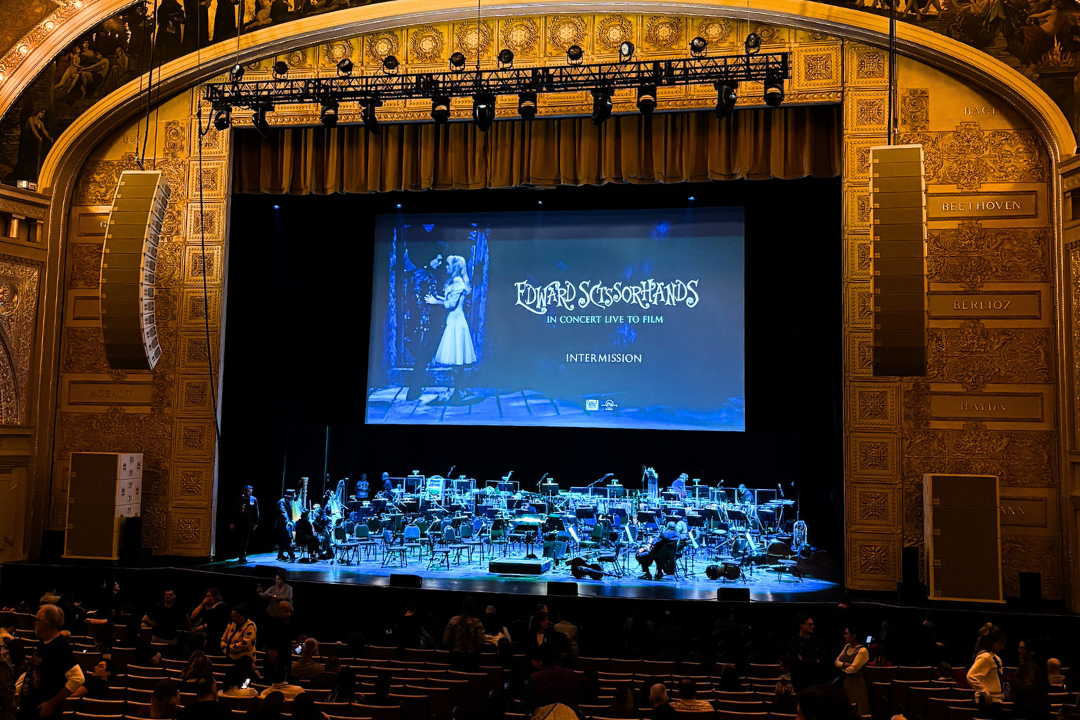
On October 24, The Auditorium in Chicago hosted a performance of Edward Scissorhands in Concert live with the Chicago Philharmonic. I leapt at the opportunity to see a film with a live orchestra, and that I could bring along my teen daughter to see a film that was new to her made it all the better.
Here are my 5 takeaways from the experience.
1. This movie still hits.
I had not seen Edward Scissorhands since the early 1990s, when it was released and then played on cable television, so seeing it on a big screen with a live orchestra was going to be a treat no matter what. But I was not prepared for my reaction to this film: I found myself quickly engrossed in the story and overcome with joy and sadness as Edward (played by Johnny Depp) made his way in his new world.
2. Remember when films had color?
Edward Scissorhands takes place in a neighborhood filled with soft pastel colors, bouffant hairdos, and gossip queens flanked by the darkness of the home of Edward’s creator. We’ve had so many years of films with muted colors and action taking place in the dark to obscure poor CGI that seeing the vibrant colors, wide-open spaces, shag carpets, and candy-colored wall telephones was almost a shock to the system but certainly a treat. The imagery and colors in this film are so highly stylized that you could almost mistake it for a Wes Anderson picture.
3. Live orchestra accompaniments are the perfect gateway into classical music.
The Chicago Philharmonic, under the direction of conductor Thiago Tiberio, showcased its tremendous musical talent by bringing the Danny Elfman score with its now-familiar themes to life in this great hall. You might struggle to get your children to a performance of Brahms, but the accessibility that comes with a popular movie and an outstanding score might just be the secret to developing new classical music fans. And if that doesn’t do the trick, most of the orchestra performed in costume for the Halloween theme, adding a touch of whimsy and showing that an orchestra does not have to be so serious to win someone over.
4. It was unexpectedly cathartic.
Kim Boggs, played by a young Winona Ryder, is in a toxic relationship with Jim, played by Anthony Michael Hall. As the film progresses Kim starts to realize that Jim is not the sort of guy she should be with, and she slowly starts to fall for Edward. Imagine my surprise when (spoiler alert!) Jim is killed toward the climax of the film and nearly the entire auditorium burst into thunderous applause. While it came as a surprise to witness this reaction, I realized audiences might be looking for vicarious justice.
5. A nod to the past.
Tim Burton’s career has always heavily borrowed from German Expressionism, and this film is no exception. As soon as Edward appeared on screen, memories of Cesare the Somnambulist from the horror classic The Cabinet of Dr. Caligari came to mind. For an audience that might have grown up on Burton’s films, this was an opportunity to look back at his inspiration.
