
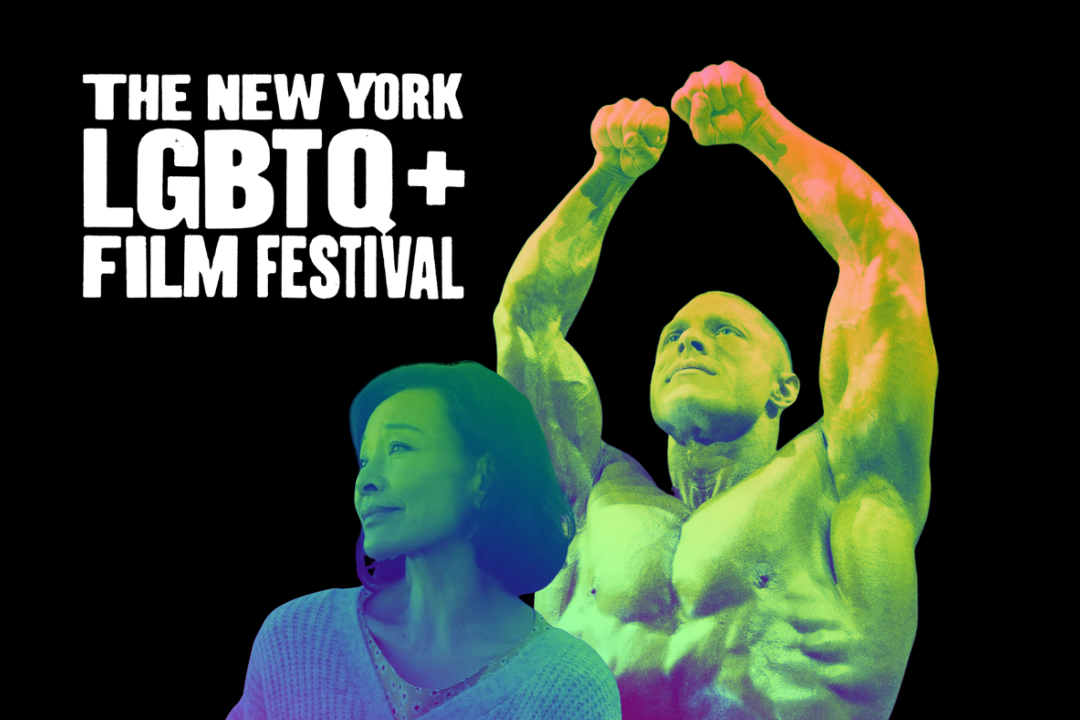
The 2026 edition of The New York LGBTQ+ Film Festival ran from October 15-25, this time spanning across three boroughs and spreading queer stories further than before. Over 140 films premiered in this year’s program, which is an impressive feat considering that many of them played to audiences in traditional movie theaters. NewFest brought back their streaming platform for select titles as well, creating access for those outside of New York City to engage with new queer films.
Across the festival, I was able to see 17 narrative and documentary features. Since there was some programming overlap with this year’s New York Film Festival, such as Blair McClendon’s Clarissa and Jordan Firstman’s Club Kid, I’ve chosen not to include those titles in my best of the fest list. (See my Top 20 Movies of NYFF 2026.) For now, here are my top 10 features from NewFest38.
10. What Will I Become?
Under the second Trump administration, conservative lawmakers across America have targeted trans adults and adolescents far greater and harsher than years prior. Gender-affirming care remains a hot-button issue in medical law, and both the state and federal court cases continue to pile up while trans youth suffer in silence. In this devastating documentary, directors Lexie Bean and Logan Rozos are a few of too many transmasculine adolescents who have attempted suicide and lived to recall the reasons they wanted to take their own life.
While there is an autobiographical element to Bean and Rozos’ structure, they choose to highlight two young trans men, Blake Brockington and Kyler Prescott, who sadly passed away from suicide—but left a legacy filled with authenticity and kindness for those who loved them. Through Tumblr screenshots, paper animation, and musical influences, Bean and Rozos outline why teen suicide rates are higher for transmasculine individuals, delivering an ode to trans lives cut short by a system that perpetually fails them.
9. Montreal, My Beautiful
About a year after its world premiere at the 2025 Festival du nouveau cinéma, Xiaodan He’s sapphic drama finally arrived in New York, bringing one of Joan Chen’s finest performances in tow. Montreal, My Beautiful follows Chen playing a Chinese Canadian immigrant (Feng Xia) living in Montreal, where she experiences a late-in-life sexual awakening when she meets a younger woman, Lisa (Charlotte Aubin). As Feng spends more time gallivanting around the city with Lisa, she drifts from her family who often take her artistic interests and general personhood for granted.
He constructs a fascinating dichotomy in Feng’s sexuality across the film as we see her in intimate moments with her husband, where he treats her like an object that he can dress to his personal fantasies, and with Lisa, where she aims to please and treasure Feng’s sensuality. The film does not treat Feng as a delicate individual, either, instead fueling her agency and complexity by framing this self-discovery as an active decision made by Feng when she downloaded a lesbian dating app. Chen does not play Feng as a victim of circumstance, but as a woman changing her circumstances to take chances that she could not in a familial setting.
8. Tiger
Another film coming stateside after its world premiere at the 30th Busan International Film Festival is Anshul Chauhan’s Tiger, which follows a mid-30s masseuse (Taiga) in contemporary Japan as he attempts to pursue a career in gay porn. When his sister calls and informs him that their father is dying, Taiga returns to his hometown to help his family get their affairs in order. A striking contrast exists between Taiga’s life in the city and his demeanor in his family’s presence, and it aptly parallels the way that queer people—especially gay men—feel they have to hide or mute their sexuality to appease predominately heterosexual communities.
In Taiga’s urban bubble, he can commit to sex work without fear of judgment from his peers, but the idea that his sister could ever know what he does for a living is catastrophic. Chauhan cleverly excites one minute with Taiga’s porn shoots and clubbing debauchery, but then jostles you back to reality with a sobering conversation between Taiga and a past lover that never escaped their conservative environment. He tenderly nudges us to remember that we all don’t get to spread our wings and fly to a new home.
7. The Riverbank (A Margem do Rio)
If you thought William Friedkin’s Cruising made public sex look dangerous, then Enoch Carvalho and Matheus Farias’ The Riverbank (A Margem do Rio) will leave you clammy in every crevice of your body. Turning the mangroves in Brazil’s Recife region into a dangerous cruising spot for queer locals, Carvalho and Farias center their neo-noir around a hot 20-something named Izaquiel (Caique Copque) who cannot keep a job due to his proclivity for sexual encounters in the workplace. As a last resort, his job coordinator places him at a Christian megachurch in a janitorial role, obviously conflicting with his out identity as a gay man.
Over the following weeks that he settles into the job, Izaquiel discovers that this church may be hiding a darker vision for Brazil under the guise of religious salvation. The film intertwines spirituality and sexuality in quite unexpected ways, but it proves that Carvalho and Farias have more conclusions to draw about the intersection between these two topics than just superficial depictions of sex ascending reality. Once the film takes its turn into thriller territory, it transforms into a gripping and shocking story of homophobia in the largest country in South America.
6. Corpus
Taking us back to the late-90s, Corrin Evans’ seductive horror debut will raise your body temperature until you can’t take the heat anymore. Evans co-wrote the film with one of its stars, Lily Cowles, and that partnership bears an incredible, detail-oriented picture about an amateur photographer skulking around the New York club scene. When this photographer, Sayo (Jeff Wahlberg), runs into his ex-boyfriend on a night out, he’s suddenly dragged into a trip upstate to party with some anonymous elites. Once they arrive, unsettling architecture and creepy houseguests lead to an overnight stay he may not come home from.
Corpus touches on a specific aesthetic associated with the underground club scene at this time: dimly-lit warehouses, leather jackets, and as much cocaine as your heart could desire. Evans’ direction is singular and sultry, with the shots from Sayo’s film camera exhibiting some of the most striking compositions I’ve seen in contemporary horror movies. As the bloodshed starts, a certain contraption rears its ugly head and kills this cast of characters in a manner that can only have been derived from the depths of hell. The whole ensemble clicks, whether that’s in their intimate scenes or luring each other into danger, and you never know which direction Evans’ is aiming the next death blow. It’s a mean, sexy film.
5. No Money No Honey
It’s been six years since the COVID-19 pandemic began, and we’re only scratching the surface of our lived experiences during this disorienting, traumatic period. In No Money No Honey, Nicole Costa documents what life was like in New York for the one and only Máxima Mauricio, an Argentine migrant who relies on sex work to survive in a moment where physical proximity is potentially lethal. As Costa interviews Mauricio about their past, Mauricio incorporates old VHS footage from their stints in Buenos Aires and Miami to platform the vibrant trans community that supported them through their transition into adulthood.
Máxima Mauricio is an enthralling documentary subject, mainly because they have no filter for their beliefs about politics or sex. Costa could have rested her camera on the kitchen counter for hours, simply recording Mauricio as they went on and on about what pisses them off and who they are still upset with from twenty years ago. While there is a world where I would love to see that cut of the film, what we have here is a delicate and sobering reflection on trans identity that sprawls across the Equator, using Mauricio’s personal archive as a portal to a time when finding our next trick is the worst of our concerns.
4. Test
Star-turning performances come to us a handful of times each year, and there are a plethora of leading and supporting roles swept under the rug once awards season kicks into high gear. If there’s one film on the periphery that you do journey to, please make it Sam McConnell’s Test. Written by and starring Brock Yurich, the film focuses on a small-town Ohio bodybuilder, Eddie, who dreams of winning the regional heavyweight championship that promises to free him of his mundane, midwestern existence. In his quest for triumph, he reaches out to an old friend’s father for training assistance, unintentionally stirring up homosexual desires he’s repressed since high school.
While Yurich’s physicality is certainly on display here, his empathy breaks through his rough exterior and cements him as this golden boy for his conservative community. Oscillating between a hyper-masculine environment in public and a lonely, fearful space when alone, Eddie’s own existence is an enigma to himself. His arc by the end of the film speaks to a sparsely covered intersection between gender, masculinity, and queerness, and his insistence on pushing his body to the edge of destruction is not so far off from how we throw ourselves into walls just to bend into the preferred shape.
3. Mickey
Winning the Global Audience Award at this year’s SXSW Film Festival, Mickey is a mixed-media documentary unlike any other in its ambition and display of the queer URL generation. Director Dano Garcia follows Mickey Cundapí (Mickey Bustamente) as they cultivate an online following through their lifestyle vlogs. In Sims-like computer games and VHS tapes, Mickey processes her sexual identity and the ways she acted out towards her family in her adolescence. Often blurring the line between truth and fiction, Mickey tempts us to solve the jigsaw puzzle that has become her existence.
Similar to No Money No Honey, Mickey lets us into an individual’s mind through media and memories that speak volumes above any documentary testimonial. In one of the film’s mixed-media scenes, Mickey recounts the time she set their family home on fire, casting her real-life father as a burn victim from the accident. Later, Mickey reveals that no one was hurt by her act of arson, but she provokes us to wonder what would have happened if she wanted everyone to be inside. We think of teen angst in the vein of John Hughes movies, but that’s such a bland representation for insecurity and repression that can evolve into legitimate violence. Perhaps that’s why Sims-style video games are so popular with queer people; we can be whoever we want, when we want, and burn it all down in the same day.
2. Coward
Lukas Dhont’s previous film, Close, proved that he could overcome the sophomore slump, but his latest feature demonstrates that the third time’s the charm. Selected as Belgium’s entry for the 99th Academy Awards, Coward tells the story of Belgian soldiers during World War I who were on the frontlines, yet they were not the ones engaging in direct combat. Instead, their unit was tasked with uplifting morale through entertainment and housekeeping tasks to keep the fighting soldiers in good spirits. One of these soldiers, Pierre (Emmanuel Macchia), is known as “Quiet Mouse” to the rest of his unit since he does not engage much in the wartime comradery. When the flamboyant Francis (Valentin Campagne) takes a liking to Pierre, the two embark on a gentle, secret love affair that Dhont’s direction compliments beautifully.
Campagne and Macchia won the dual Best Actor prize at this year’s Cannes Film Festival for the film, and it’s a crime they are not in more conversations for acting accolades in the States. Their yearning for one another remains palpable as it breaks through crowds of scarred soldiers and inhospitable accommodations, exuding a “love conquers all” attitude that is hard to believe nowadays. In the moments they get to hold each other’s fragile frames, Dhont abstracts their bodies into mere piles of flesh folding in on themselves, like they are melting into one body. We’ve seen gays in war epics plenty of times before, but not as endearing as this.
1. Sinner Supper Club
Girls, gays, and theys—we have another hit on our hands. Nora Kaye and Daisy Rosato’s Sinner Supper Club is billed as a “gay mumblegore ghost story,” but I’d go so far as to say it is queer classic arriving at the perfect point in the zeitgeist. The comedy revolves around a group of New York friends throwing an eviction funeral for Genevieve (Genevieve Simon), who has been priced out of their apartment. On a sweltering summer day, they bounce from city parks to new-construction rooftops in search of the perfect farewell for their friend in mourning. However, their air-conditioned solace turns into a nightmare when a dead friend reappears to haunt them.
Kaye and Rosato shot the film in six days on an iPhone, giving each frame that .5 zoom effect that plays with your depth of vision. Practically, this saved them money on professional film equipment, but it also contributed to the quick-snap line deliveries and chaotic atmosphere that envelops this dysfunctional friend group. They also wrote a manifesto for the film that speaks to filmmaking conditions and costs for aspiring directors, hoping to highlight the inequities plaguing those interested in telling queer narratives. Factory 25 acquired worldwide rights to the film last month, so plan to catch this in theaters with your Bushwick besties next spring.
