
Why ‘Pirates of the Caribbean: Dead Man’s Chest’ Remains a Treasure
The Scoop features personal essays on movie-related topics.
For some reason, Pirates of the Caribbean: Dead Man’s Chest was the first of Disney’s swashbuckling action-adventure franchise I watched as a kid. Being the dying embers of the physical media era, my parents had a DVD of the film that they must have received as a gift or picked up for a dollar at the supermarket for a laugh. One night they decided to pop it in, and although I had absolutely zero context for it, I was awestruck.
Now, to celebrate the film’s 20th anniversary, I’m raising my sword to honor director Gore Verbinski’s approach of departing slightly from the relatively grounded nature of his first film and assembling a mighty ship’s worth of meticulously constructed set pieces, memorable character moments, and masterful atmosphere setting.
Characters, Old and New
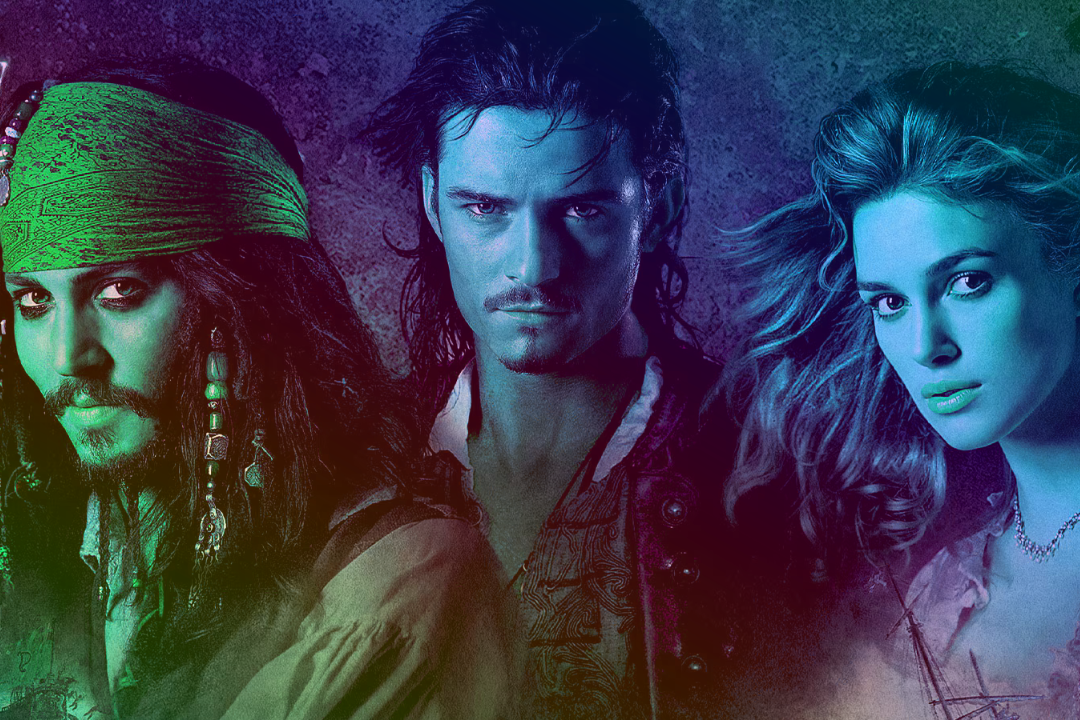
Although CAPTAIN Jack Sparrow (Johnny Depp) is as chaotic, comedic, and conniving as before, he is a somewhat different character than the one we fell in love with in The Curse of the Black Pearl. Whereas he was a wronged man looking for revenge in the first film, which gave him a certain edge even amongst his goofiness, here he is a coward running away from his debt, creating a fully realized arc about learning to do the right thing.
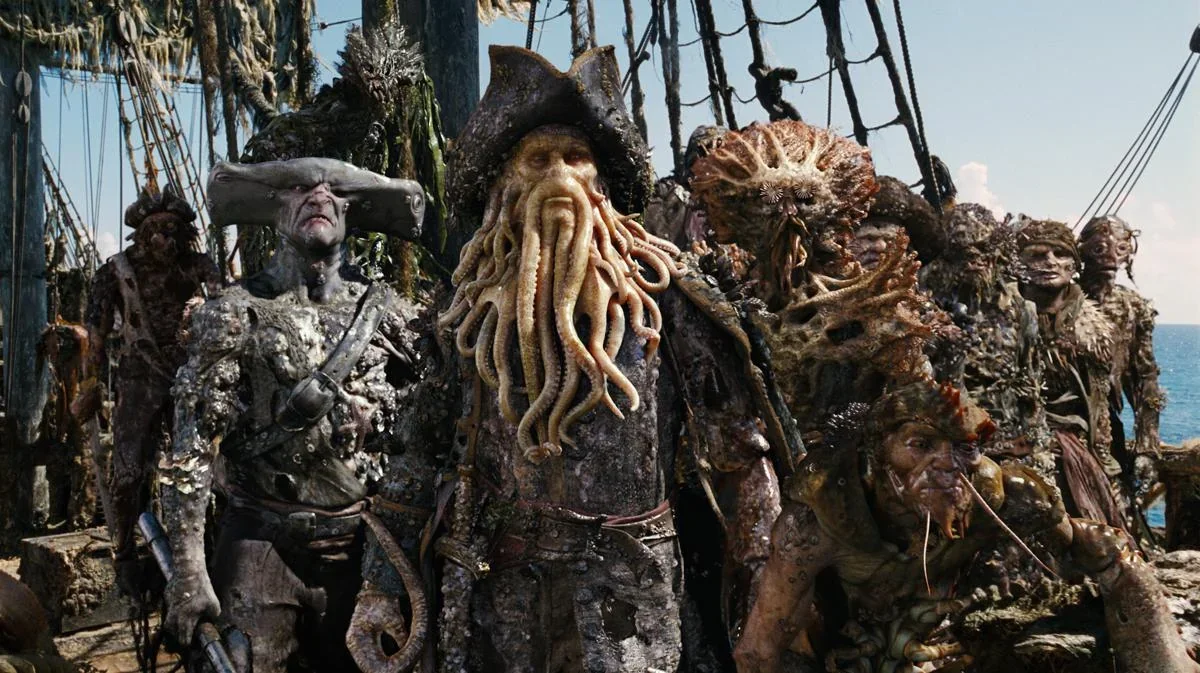
Of course, we have to talk about Davy Jones (Bill Nighy). Aside from being a marvel of visual effects that more than holds up twenty years on, he is also teased in the film as being a rather layered character. The romance of his everlasting duty to shepherd lost souls on the Dutchman is compounded by the allusions to the tragedy of his relationship with Calypso. These ideas are developed further in At World’s End, but they serve here to inject a subtle softness and complexity into an otherwise one-dimensionally terrifying villain. Similarly, Naomi Harris’s Tia Dalma, our bewitching Caribbean-accented guide to the spirit world, has more to do in the next film, but her flirtations, command of the room, and ferocious nature make her a memorable addition.
One of my favorite additions to the cast is the icy cold Lord Cutler Beckett, played commandingly by Tom Hollander. The first thing he does is arrest our heroes with a sardonic playfulness, and he continues throughout the film to be an imposing presence with a singularly dismissive tone. In contrast, I always find myself feeling sorry for ex-Commodore James Norrington (Jack Davenport), despite the inherent comedy of his disheveled appearance, the events of the previous film having destroyed his faith in the principles he was brought up on. Between Black Pearl and this sequel, we don’t see Norrington’s resignation as Commodore, but it comes as little surprise.
Will (Orlando Bloom) doesn’t have a whole lot to do in this one, functioning largely as a loveably dumb yet headstrong golden retriever, but his fiancé Elizabeth (Keira Knightley) finds herself with a larger role this time around, at least by way of actual pirating. She threatens Beckett at gunpoint, hitches a ride to Tortuga disguised as a man, participates in the customary brawl there, and later holds off Davy Jones’s crew. It’s an indication that she, deep down, desires the freedom and thrill that comes with the pirate’s life.
Finally, Pintel and Ragetti, the bumbling duo of dimwits from the crew of the Pearl, are given more of the spotlight in this second installment. Their constant bickering is always a treat, and their distinct characteristics are even more emphasized, Ragetti clearly fancying himself an intellectual and Pintel being contrastingly brutish and bossy. Their first scene on the rowboat is a real standout—“It’s the Bible, you get points for trying!” is one of my favorite lines in the franchise.
Set Pieces
Isla de Pelegostos
The escape from the cannibalistic Isla de Pelegostos is the first of a few prolonged and epic action set pieces the film serves up for us. It’s a classic seesawing sequence of chaotic events, constantly finding ways for the Pelegostos to go back and forth between chasing Jack and the crew of the Pearl.
It also boasts some of Verbinski & Co.’s formal talents in elevating their characters’ circumstances. I’m thinking here of the visual comedy of the whip pan to reveal Jack gone from the tribe’s sight and the immediate cut to the wide of him frantically running across the bridge, or the whimsical classical music accompanying Will and the crew’s attempts to escape from the abyss they’ve been encaged over.
Tortuga (Pt. 2)
It’s only a mini-sequence, but I have to give a shout-out to the brilliant brawl that takes place on our return to the debauched port town. Something always goes down there, and when it’s one person’s fight, it becomes everybody’s. There’s just something infectious about the kind of seedy bar where Jack can leisurely try on hats and the drunken regulars are polite enough to let him pass by before they hurl someone over the railings.
Isla Cruces
This might be the best of the lot. Longer, more dynamic, and with more players involved than even what transpired on Isla de Pelegostos, the Isla Cruces sequence deep into the film is probably the best of the series, and maybe even the last couple decades of action-adventure filmmaking. At the heart of its success is the vast range of its characters’ competing motivations as well as the complication introduced by the three-layered MacGuffin of the Heart of Davy Jones, the chest it’s kept in, and the key that unlocks the chest. This provides plenty of incentive for the franchise’s trademark sword pointing and re-pointing, where characters are in one moment diametrically opposed to one another and in the next politically aligned with each other against a common foe, and vice versa, and on and on it goes. It’s a comedy of errors in action movie form.
The Kraken vs. The Black Pearl
Any discussion about this movie would be incomplete without mentioning the big Scandinavian mythological beastie always lurking beneath the waters throughout its runtime. After a quick and vicious encounter that Will only narrowly escapes, the Dutchman summons the ship-sinking creature one last time to go after the Black Pearl. There’s a lot to love about this sequence: the abject terror of the giant squid’s tentacles slowly moving up the ship’s hull, followed by the suspense of Will’s order to fire, the violent chaos of its fury when it returns, and the desperation of the crew’s gunpowder scheme. It leads perfectly into Jack’s triumphant return, his forced sacrifice, and the awe of seeing the monster in its full glory. Which leads us into…
Incredible Visual Effects
John Knoll and the team at ILM followed their work on Black Pearl, which included constructing Barbossa’s undead crew, by providing the gold standard for visual effects at the time. Their crowning achievement was Davy Jones, for which they developed a piece of motion-capture technology called Imocap that allowed Bill Nighy’s excellent performance to be captured in real time on set. Every detail and mannerism of his was clearly translated while interacting with his meticulously animated tentacles to create a seamless CGI character.
There were also a great deal of practical effects, from the prosthetics on Bootstrap Bill to the slime lurched at Jack from the mouth of the Kraken to ship models and mini-water bodies constructed to simulate a real ship at sea. With a budget of $225 million, it was the most expensive film made to date, but unlike many of the blockbusters of the better part of the past decade, you could actually see that come to fruition on screen.
Dead Man’s Chest is by no means a perfect movie, and it asks you to buy into some pretty ridiculous notions, even by the franchise’s standards. But twenty years on, it feels like one of the last examples of a bygone era when big budget blockbusters actually felt inventive, entertaining, and worth our time.