
Review: ‘The Odyssey’ is moviemaking at the highest level
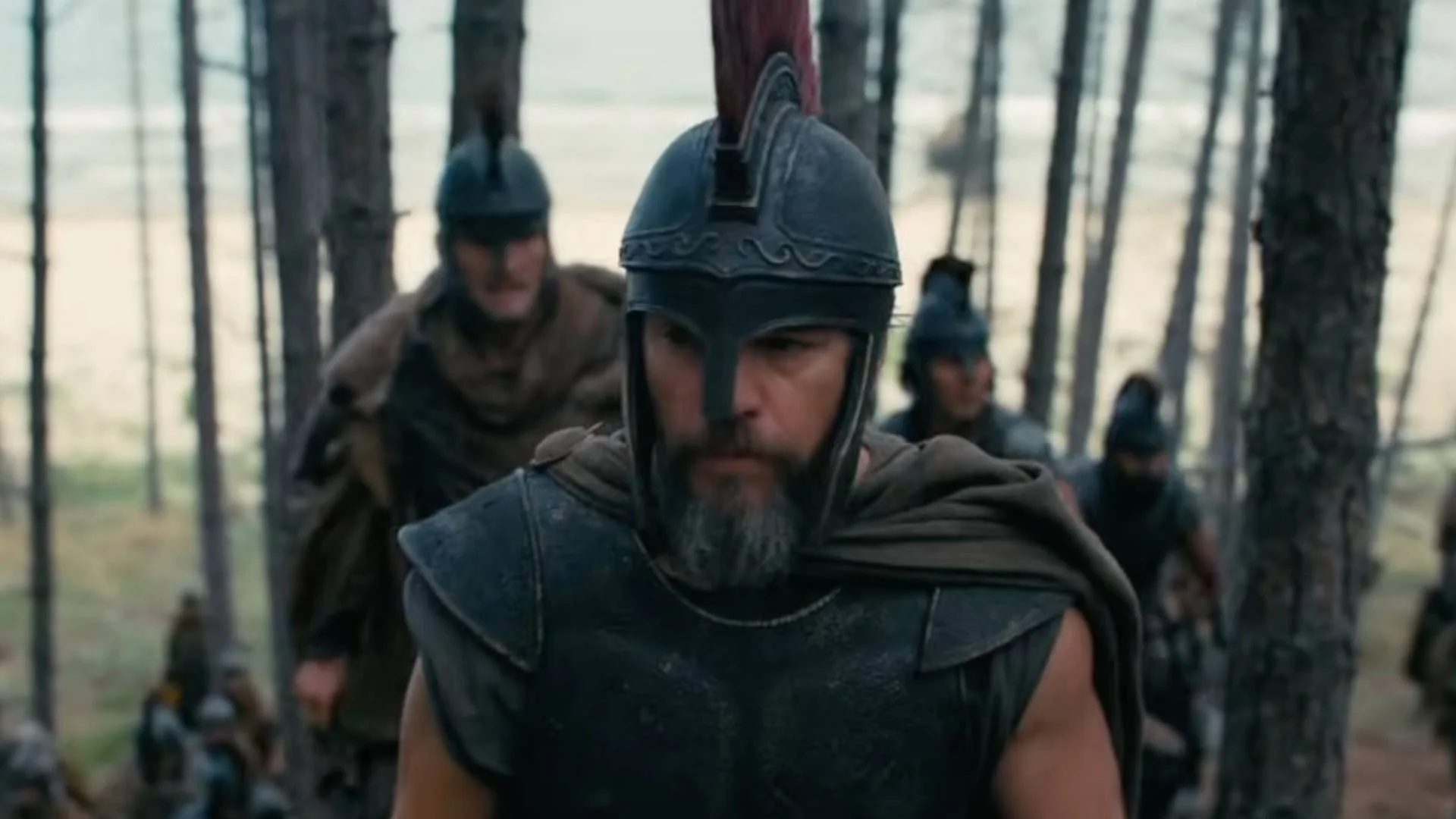
2026 / Dir. Christopher Nolan
Rating: 4/5
Watch if you like: the films of Christopher Nolan, not wasting your time with all the dumb internet discourse about this movie, not being a racist who’s capable of watching a movie with a black person in it, the feeling when you come back home and your dog is overjoyed to see you.
We’re finally here. The movie of the summer: Christopher Nolan’s The Odyssey. Surprisingly, or unsurprisingly in this day and age, the film’s attracted a wide variety of controversy from everyone from racist trolls angered about casting to Nolan not making a historically accurate take on a myth. What we end up with is a staggering, impressively crafted epic in the Christopher Nolan style he’s favored since Dunkirk, eschewing commercial Hollywoodisms for his own idiosyncratic vision.
First off, I have to address the technical limitations of the 70mm screening I saw. The projector wasn’t centered, and there was an uneven, hazy gray bar at the top of the screen. Picture quality didn’t seem to be what it should be, and neither did the audio. The latter is difficult to tell because Nolan films are known for difficult-to-understand dialogue, and while clearer than Tom Hardy’s marble-mouthed Bane, I couldn’t understand some important scenes. However, the music also seemed muddled, so I’m leaning toward it being due to the theater’s projection difficulties. Certainly, this ruined some of the immersion for me and may have impacted my score.
As with the book, The Odyssey begins near the end of things with Trojan War “hero” Odysseus (Matt Damon) still MIA eight years after the war ended and his kingdom of Ithaca slowly being sucked dry by dozens of slovenly suitors trying to make life so unpleasant for Odysseus’s wife Penelope (Anne Hathaway) and son Telemachus (Tom Holland) that she’ll remarry and he’ll lay aside any claims to the throne. Odysseus doesn’t make a real appearance in the first half hour, which seems intentionally chaotic and slightly impenetrable to mirror what Ithaca is going through. While this is a fairly faithful retelling of Homer’s Greek epic that also incorporates bits of The Iliad and Virgil’s The Aeneid, Nolan never holds your hand, and you’re going to be scraping the far recesses of your brain at times to remember your high school English class to put meaning to a string of ancient Greek names like Agamemnon, Menelaus, and Clytamnestra.
The movie gets more decipherable when we’re introduced to Odysseus, struggling to remember who he is and what happened to his crew while stuck on an island with Calypso (Charlize Theron) and an endless supply of mind-numbing lotus flowers. Time is an abstract concept in Nolan movies, woven like the funeral shroud Penelope weaves and unweaves each night, trying to delay her husband's return by another day. Nolan seamlessly guides us through Odysseus’s fractured flashbacks, spanning periods before, during, and after the war, as well as Telemachus and Penelope’s present and their flashbacks from their perspective. We’re sometimes in a story within a story, but it’s all in service of a portrait of a prickly man struggling to deal with fate, guilt, and the horrors he’s wrought.
It’s hard to say a film that features a one-eyed giant, sirens, and tentacle creatures is “naturalistic,” but The Odyssey is tactile; Nolan wants you to feel like you’re there and could reach out your hand and be lost at sea. Much of this is due to filming in real locations rather than relying solely on VFX. Something that seems as simplistic as men aboard a ship on the sea feels massive because there’s an actual ship that Matt Damon is piloting on the ocean. When Trojan slaves haul the Trojan Horse out of the sand and into the city, it feels legendary. This extends to the lighting, full of night scenes lit seemingly only by torchlight, and a score created with ancient instruments by Ludwig Göransson.
Even the more fantastical moments have a tangible quality. The Cyclops, with its twisted features, looks as if you could touch it and feel weathered skin. An encounter with the witch Circe leads to a sequence of grotesque body horror that makes you wish Nolan would try out making a scary movie next. Apart from brief appearances by Athena (Zendaya), who is only noticeable to Odysseus, Nolan smartly excises the gods themselves and their direct manipulations found in the original epic.
Nolan first drew attention for his film Memento, a literal puzzle to be solved to decipher what really was going on. Even with Oppenheimer, you were waiting to see the different timelines converge to understand the themes being presented. The Odyssey is similar in that regard, where it’s deceptively straightforward, and the difficulty was mainly in trying to parse through a massive cast of celebrities and miniature storylines inside a largely cohesive whole. I struggled to make an emotional connection, other than Odysseus’s dog living past his lifespan hoping to see his master once more, or even to make sense of the intent here, beyond just retelling this classic story in a modern way.
That is the point, though, and Nolan sticks the landing by making The Odyssey and its hero feel as relevant as ever. Damon’s not my favorite dramatic actor, but he’s been cast for good reason, using his prickly demeanor to show a man both fed up with the hand that’s been dealt to him, willing to cut any corner to get home, and haunted by the man he’s been forced to become. We see his men burn villages for food and, during the fall of Troy, kill women and children. The real odyssey is to make sense of not just how to live in a world of cruelty, but how to live with yourself as part of it.
I expect The Odyssey will work even better for me on a second viewing, as most Nolan films do, and I’m already starting to appreciate it more and more. Even with so much to decipher, it needs to be mentioned how astounding Anne Hathaway is without a ton of screentime. Her performance is a masterclass of emotion, and she makes Penelope come alive more than anyone else in the film (Pattinson may be a close second for different reasons, as a slimeball suitor). I would be shocked if she didn’t get an Oscar nomination.
Unless you’ve rotted your brain by spending too much time online, you’re going to see this movie no matter what I have to say. If nothing else, do your due diligence by seeing this on the largest, highest-quality screen possible. If your local chain cineplex is showing this in 70 mm and doesn’t typically show film anymore, maybe give them a couple of days to figure out how to project a movie. This is moviemaking at the highest level, filmed on IMAX cameras and, more so than any other film in recent memory, the experience will not be the same at home or with low-quality projection.