
Review: ‘Saccharine’ vivisects the horrors of diet culture
2026 / Dir. Natalie Erika James
Rating: 3.5/5
Watch if you like: Raw, The Substance, It Follows, eating dead people’s ashes so you can score with your hot personal trainer, mainlining a 7-11 Slurpee straight from the tap so that you don’t have to be haunted by the ghost of the woman you ingested so that you could score with your hot personal trainer.
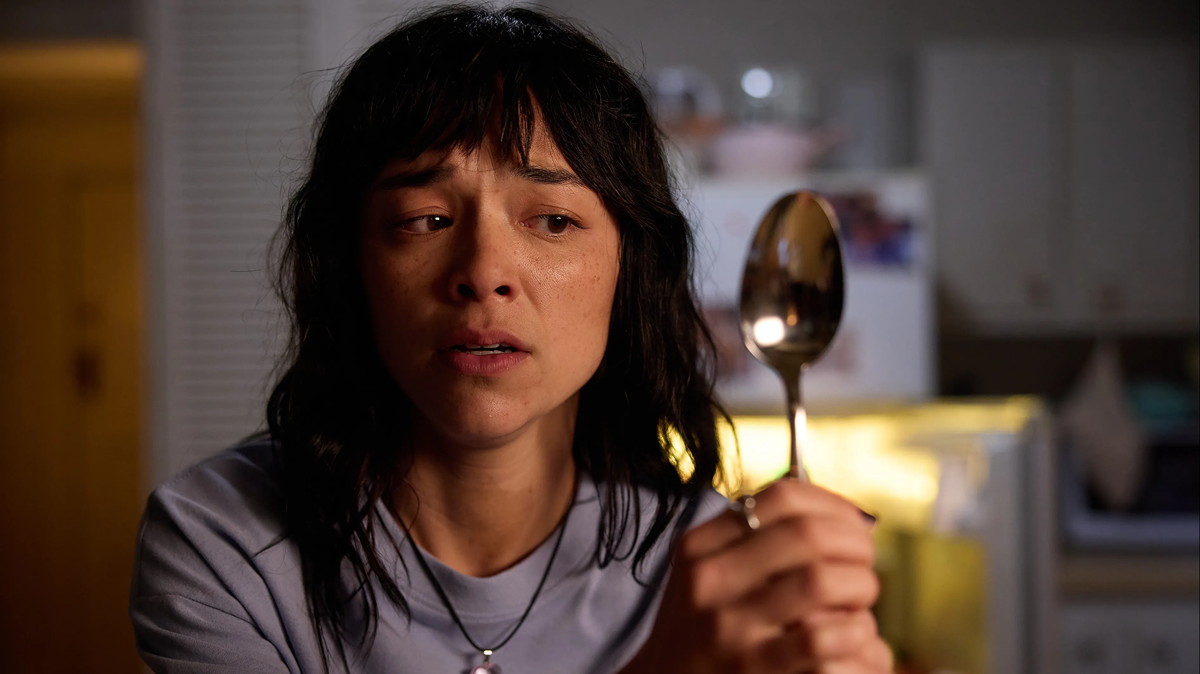
A woman gorges herself on glossy, perfectly lit food going in and out of her mouth in different stages of mastication while the camera cuts in between the curves of a thinner woman in tight workout clothes riding a bike. This is the barrage of desire and craving that Hana (Midori Francis, Ocean’s 8, Grey’s Anatomy) experiences every day, not to mention the constant feed of competing body positivity and weight-loss trend TikToks on her feed, or her stick-thin mother sending her photos of her morbidly obese father as a warning to never get that big. While they don’t have Ozempic in Australia in Natalie Erika James’s new diet culture horror film Saccharine, they do have pills made out of dead people’s ashes!
Saccharine initially comes across as subtle as a sledgehammer, but reveals itself as a very ambitious vivisection of body image, from the ways women are shaped by competing media to the idea that body image itself is an inherited “trait” from our parents’ own issues. James, whose debut film Relic I was quite taken with, makes the clever decision to have Hana be too smart for her own good. When Hana runs into a formerly obese classmate who is now model thin, she’s told about a mysterious new diet pill dubbed Grey (it is literally a grey powder in a capsule).
Most horror films would reveal that the pills are made from dead people near the end, but Hana is a medical student, and her first instinct is to test the pills. That revelation doesn’t stop her, and because the pills are expensive, she decides to make her own…out of the cadaver she’s been using in her anatomy lab. And when she starts seeing the ghost of the derisively named “Big Bertha” for her size, she starts taking notes about the sightings and formulating theories. Most of these sightings aren’t particularly scary, but result in genuinely gross situations. Midori Francis gives it her all as Hana often finds herself gorging on all manner of disgusting things that don’t always qualify as food. To keep losing weight, Bertha needs Hana to eat more and more.
Saccharine works best when it refuses to follow horror or “makeover” movie tropes, or when it seems to actively rewire our brains by rendering disgusting images in a beautifully shot way. Hana is a different type of horror lead, and by making her an overanalyzer, the narrative takes unique and interesting turns, even as she still can’t help but succumb to her own internal programming and logic. One of the best instances of this is through the developing relationship between her and her trainer, Alanya (Madeleine Madden, The Wheel of Time), whom Hana both has a crush on and idealizes as having the perfect body. When Hana achieves her ideal weight, she expects Alanya to welcome her into the inner circle of thin, beautiful people and be proud of her, not anticipating Alanya to respond with alarm and concern over her dramatic transformation.
The film stumbles as it tries to take on more than any film possibly can, with the nearly two-hour runtime seemingly there solely to cram in another body-image-related side quest, like Hana’s relationships with each of her parents. With the horror elements, the length also means scene after scene of Hana gorging quickly lose their impact. Still, I’d rather see a messy film packed with ideas that challenge the status quo of its genre and society.
Though I didn’t find Saccharine as effective as Relic, I deeply admire the shots she takes here in another unique twist on the horror genre. Like peers Coralie Fargeat and Julia Ducournau, who use body horror to deconstruct the state of modern women, James, in what is still a relatively short directorial career, is making visionary films that stand on their own amidst a crowded house of A24 and Blumhouse productions.